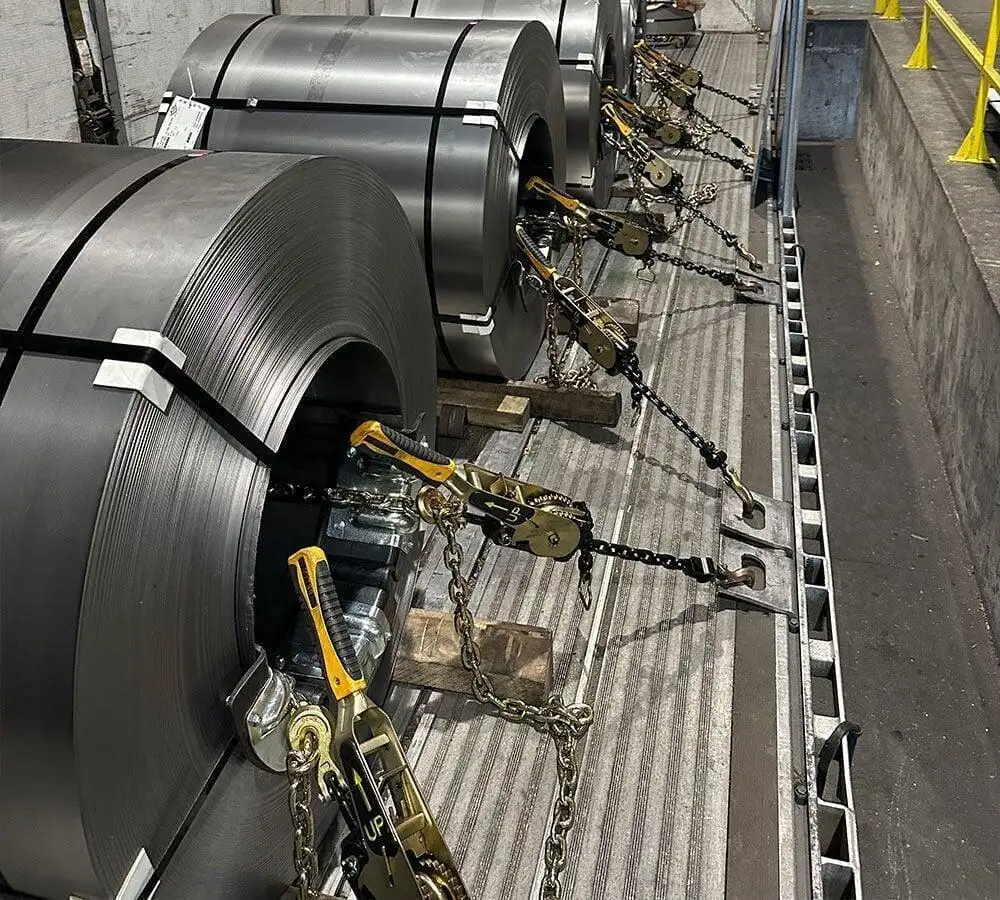
Few loads on the highway demand more respect than steel coils. A single coil can run from 5,000 pounds to well over 40,000, and if one shifts, the results can be catastrophic — for you and for everyone around you. That's why the FMCSA wrote a securement standard just for metal coils, and why the best steel haulers don't guess. They calculate, they place the load themselves, and when their gut says the minimum isn't enough, they add more.
ApplicabilityWhen the Coil Rule Applies
The specific metal-coil rules kick in whenever one or more coils weigh 5,000 pounds (2,268 kg) or more, either individually or as a group. If every coil on the load weighs less than 5,000 pounds, you're allowed to fall back on the general cargo securement rules in §§393.100–393.114 instead.
Coil securement methods are set by 49 CFR §393.120. The working-load-limit math that runs alongside them comes from the general rule, 49 CFR §393.106. You have to satisfy both — the right method and enough combined strength.
PhysicsWhy Steel Coils Are Different
Unlike most freight, a coil concentrates enormous weight onto a small footprint and carries tremendous momentum. A coil that starts to move doesn't nudge — it lunges. Even a slight shift can make the truck unstable, destroy your securement, damage the trailer, or put tons of steel on the road. That's why the method you use depends entirely on how the coil sits on the deck: eyes vertical, eyes crosswise, or eyes lengthwise. Each orientation gets secured differently, because each one fails differently.
Never let the shipper's loader set those coils wherever they want on your deck. You tell them where the coils go. Only you know your trailer — where your weight points are, where it's rated to carry that kind of concentrated load, and where it isn't.
A coil puts tens of thousands of pounds on a tiny footprint. Put it in the wrong spot and you can break the flatbed in half — I've seen it happen more than once. It's your trailer, your CDL, and your neck. You place the load.
Recommended Coil Securement Gear
3/8" G70 ChainSteel Coil RacksWhat I carry for coils: Steel coils will punish cheap gear, so I run 3/8" Grade 70 chain through the eye with heavy-duty coil racks under the dunnage to keep the load cradled off the deck.
Shop options on Amazon → Shop options on Amazon →Method 1 · §393.120(b)Coils With Eyes Vertical
An "eyes vertical" coil stands upright, with the center opening pointing at the sky. For a single coil, the regulation doesn't hand you one fixed pattern — it tells you the goal: the tiedowns must be arranged to prevent the coil from tipping forward, rearward, or to either side. In practice that's done with tiedowns run through the eye and arranged to catch the coil in every direction.
If you run a tiedown over the top of the coil, the rule is specific: it has to sit as close as practicable to the eye and be positioned so it can't slip off or work loose in transit. When coils are loaded in rows, each row needs a forward restraint, a rearward restraint, and at least one tiedown over each coil or row — arranged, again, to stop shifting and tipping in every direction.
Method 2 · §393.120(c)Coils With Eyes Crosswise
An "eyes crosswise" coil lies on its side with the opening facing out toward each side of the trailer — the way the coils sit in the photo at the top of this page. Before a single chain goes on, the coil must be stopped from rolling using coil bunks, a cradle, timbers, chocks, or wedges. That rolling-prevention has to lift the coil slightly off the deck and can't be able to come loose in transit.
Nailing wood blocks to the deck as your only means of stopping the roll is prohibited. If you use timbers, chocks, or wedges, they have to be held in place by coil bunks or a similar device.
Then the coil needs at least one tiedown through the eye restraining forward motion and at least one through the eye restraining rearward motion — each, whenever practicable, at no more than a 45° angle to the deck when you look at it from the side.
Method 3 · §393.120(d)Coils With Eyes Lengthwise — the "Suicide Coil"
An "eyes lengthwise" coil lies on its side with the opening facing the front and rear of the trailer. Drivers call this the suicide coil, and the name is earned: if it ever breaks loose, it rolls forward — straight at the cab.
The headache rack will not save you. A loose coil this size will fold that rack like a pancake and keep coming. So on a lengthwise coil, the FMCSA number is exactly that — a minimum.
Add more chains. Every time. The regulation keeps you legal; the extra chains keep you alive. No inspector ever wrote a ticket for a coil that was too well secured.
The regulation gives you three acceptable methods. All three start with rolling prevention (bunks, cradle, wedges, or chocks — never nailed blocking alone):
- Option 1: two diagonal tiedowns through the eye, one tiedown over the top, plus blocking or friction mats against lengthwise movement.
- Option 2: two straight tiedowns through the eye, one tiedown over the top, plus blocking or friction mats.
- Option 3: two tiedowns over the top — one near the front of the coil, one near the rear — plus blocking or friction mats.
For similar-diameter coils loaded in a lengthwise row, each row needs rolling prevention, two over-the-top tiedowns (one front, one rear), and blocking, bracing, or friction mats to stop movement.
The Math · §393.106Working Load Limit: How Compliance Is Really Measured
When a DOT inspector stops a steel hauler, one of the first questions they answer is simple: does the combined working load limit of the tiedowns meet the federal requirement? Most drivers fixate on the number of chains. The FMCSA doesn't count chains — it measures combined Working Load Limit. That difference is the line between a clean inspection and a citation.
What Working Load Limit means
Working Load Limit (WLL) is the maximum load a tiedown assembly is rated to hold in normal service — the chain, the strap or wire rope, the hooks, the binder, and the anchor points, all together.
The lowest-rated component sets the WLL of the whole assembly. A 3/8" Grade 70 chain rated at 6,600 lbs run through a hook rated at 5,400 lbs is a 5,400-lb tiedown — not 6,600. Your assembly is only as strong as its weakest link, literally.
The federal requirement
For most cargo, steel coils included, the aggregate WLL of all your tiedowns must be at least 50% of the weight of the cargo. Put simply:
One note that keeps you airtight: how a tiedown counts depends on how it's attached. A tiedown running from a deck anchor over or through the coil and back down to an anchor on the opposite side counts its full WLL; one that only goes from the deck to an attachment point on the load, or anchors back on the same side, counts half. Through-the-eye coil chains anchored on both sides generally count full — but know which kind you're running before you do the math.
Run the numbersWorked Examples
Single steel coil — compliant
The common mistake — counting chains, not WLL
Four chains, and still under-secured. More chains didn't help — smaller chain has a lower rating. It's the combined WLL that counts, not the count.
Quick reference: Grade 70 chain WLL
| Chain size | Working Load Limit |
|---|---|
| 5/16" | 4,700 lbs |
| 3/8" | 6,600 lbs |
| 1/2" | 11,300 lbs |
| 5/8" | 15,800 lbs |
Always verify the manufacturer's rating tags and markings — ratings vary by grade and maker. A tiedown with a missing, illegible, or damaged WLL tag counts as zero toward your total.
The hidden failureDamaged Equipment Can Sink a Compliant Load
A chain that's visibly stretched, cracked, gouged, or bent can be pulled out of service on the spot. When an inspector rejects a damaged tiedown, its WLL drops to zero — and a load that penciled out as compliant becomes a violation in the time it takes to walk the trailer.
One bad chain flips the whole load
RoadsideHow Inspectors Calculate Your WLL
A Level I inspector generally works it the same way every time:
- Pull the cargo weight from the shipping papers or scale data.
- Calculate 50% of that weight — the required aggregate WLL.
- Identify each tiedown's WLL (by the tags and markings).
- Add them up.
- Compare the total to the required minimum.
Alongside the math, they're checking the hardware: chain size and grade markings, binder condition, hook ratings, anchor-point integrity, any sign of stretched or damaged chain, and whether the securement method actually matches the coil's orientation.
If a coil ever works loose, or you can see one about to get away from the flatbed — get clear and stay clear. Do not try to winch it back into place. A shifting coil has thousands of pounds of momentum, and trying to muscle or winch it will kill you.
Move away, and call a wrecker — a three-ton or bigger — and let the equipment set it back. No load on earth is worth your life. The steel can be re-set. You can't.
The rule of thumb — run it on every coil load
- Determine the cargo weight.
- Divide by 2 — that's your required aggregate WLL.
- Add up the WLL of every tiedown on the load.
- Confirm the total exceeds the requirement — and on a suicide coil, exceed it by a good margin.
Bottom lineThe Best Steel Haulers Don't Guess
Working Load Limit isn't a paperwork exercise — it's the engineering foundation under the whole load. A properly secured coil depends on both the correct configuration under §393.120 and sufficient aggregate WLL under §393.106. Miss either and you've got a non-compliant load, no matter how tight it looks.
Before every trip: know your cargo weight, know your chain ratings, know your aggregate WLL. When an inspector asks how you decided the load was compliant, you should be able to walk the calculation right there on the shoulder. And when your years in the seat tell you the minimum isn't enough — listen to them, and add another chain.
And once that steel is chained down tight, covering it for the road is its own job — a proper set of steel tarps is a real investment worth understanding before you buy.
45,000 lb eye-lengthwise coil — the professional setup
Quick answersSteel Coil Securement FAQ
The FMCSA doesn't count chains — it measures combined Working Load Limit. Your tiedowns' aggregate WLL must be at least half the cargo weight (49 CFR §393.106). A 36,000-lb coil needs 18,000 lbs of WLL, which three 3/8" Grade 70 chains (6,600 lbs each, 19,800 total) satisfy — but four 5/16" chains (18,800 total) would not cover a 42,000-lb coil. Run the math, not the count.
3/8" Grade 70 transport chain (6,600 lbs WLL) is the working standard for coil work; 1/2" Grade 70 (11,300 lbs) shows up on the heaviest loads. Whatever you run, the WLL must be legible on the tag or markings — an unmarked or damaged tiedown counts as zero toward your total.
A coil loaded with its eye facing front-to-rear (eyes lengthwise, §393.120(d)). If it breaks loose it rolls forward — straight at the cab, and a headache rack will not stop it. The regulation offers three securement methods, all starting with rolling prevention; experienced haulers treat the federal minimum as exactly that and add chains beyond it.
49 CFR §393.120 applies whenever coils weigh 5,000 lbs or more, individually or grouped together. If every coil aboard is under 5,000 lbs, the general securement rules (§§393.100–393.114) govern instead.
No. On an eyes-crosswise coil, crossing tiedowns diagonally through the eye to form an X (viewed from above) is prohibited. Run straight tiedowns through the eye — at least one restraining forward and one restraining rearward motion, each at no more than a 45° angle to the deck where practicable — after the coil is blocked against rolling.
A few things that go with a coil load, each covered in its own guide: whether the rest of the freight wants chains or straps, where ratchet straps earn their place on bundled steel, and why a coil never rides under a lumber tarp. Before you pull out, measure the load height and let a truck GPS route you around the low bridges.
Sources: the load limits, tie-down counts, and securement requirements in this article come from the federal rules — 49 CFR §393.120 — metal coil securement · 49 CFR §393.106 — general securement rules · 49 CFR §393.114 — front end structures · 49 CFR §393.108 — working load limits · FMCSA Driver's Handbook to Cargo Securement.
This guide explains the federal cargo securement requirements in plain language and is written from real hauling experience; it is educational and is not legal advice. The controlling rules are the actual text of 49 CFR §393.106 and §393.120 — always verify against the current regulation and your equipment's manufacturer ratings. State and provincial rules, and your carrier's own policies, may add requirements. When in doubt, secure the load as if no exemption exists.